
How do we stay human, embodied, and joyful as the world crumbles?

In the past several weeks, since both my children left for college, I’ve experienced moments of freedom—even joy. Hints of possibility, prompting me to expand and explore.
My routines remain fairly the same, despite having more time and space on my hands. Except there isn’t as much pressure. I don’t feel the same burden on my shoulders—the kind that has slowed me down, made my back ache.
While I want to more fully relish this new era of my life, worry distracts me. There’s something new I’d like to summon. I catch glimpses of it until something jolts me, stops me in my tracks. A reminder that grief may not yet be done with me.
Most days, I only read the headlines. It’s difficult to take in the daily details of the catastrophe. I’m too consumed with recovering from the personal storms and faultlines that shook my world this past summer.
Still, angst seeps in. At the supermarket, I think to myself, “Maybe I should dress up, even when coming here. What if I’m profiled?” A pang of guilt wells up as I realize my desire to cash in on my privilege—to separate myself from the others. Hired hands, laborers, nannies. To want to feel safe while people are unjustly snatched up by thugs in masks.
While I’d like to imagine myself immune, that my privilege protects me, if the mercenaries descend, they won’t care about my U.S. passport or that I’m still paying off graduate studies. They won’t guess that I’m a professional, that English is my first language, the United States my only home.
I want to brush off these thoughts as illogical, paranoid. And a voice whispers: “Not only possible, probable. It’s already here.”
At the store, the zucchini are limp, the lemons rock hard, and there’s no cauliflower in sight. I think of my maternal grandparents, who met during the Second Great War. Food rations and bombings— uncertainty and deprivation shaped their lives. How will we prepare for what’s next?
How did my thoughts descend so quickly to this underworld? How do I step into a newfound freedom while this nation declines into fascism?
Then, in the middle of this heaviness, scrolling to distract myself— a burst of color and aliveness. Images of Celia Cruz fill my feed—commemorating her 100th birthday. (She died in 2003, at the age of 77.)
A video from the Apollo Theater’s archive shows a 60-year-old Celia belting out a song in a blue shimmering dress. Her voice was powerful, her movements effortless. Unabashedly feeling the music, dancing and swaying her hips.
I watched the video several times over. This is what it looks like to take up space, to generously exude vitality and joy. In her body, at her age, with her style, in no way was she diminished. Captivating, in her glittery gown with her bold jewelry and sultry voice. She, the embodiment of a fully actualized woman.
Searching for inspiration and clues for how to navigate darkness, I’d been watching documentaries about freedom fighters and great thinkers — Harriet Tubman, Frederick Douglass, even Hannah Arendt. It hadn’t occurred to me, until now, to turn to Celia Cruz.
Watching her, in awe, I wondered how she had ascended to such prominence in a male-dominated industry. Her life force, her power, her presence transcended many of the constraints and barriers still in place today.
She acted as if obstacles didn’t exist.
I recalled having the good fortune of meeting Ms. Cruz in 1980, when I was five or six years old. She was larger than life—friendly and warm, with a gap-toothed smile. She gifted me an autographed portrait of herself in braids with beads on the ends.
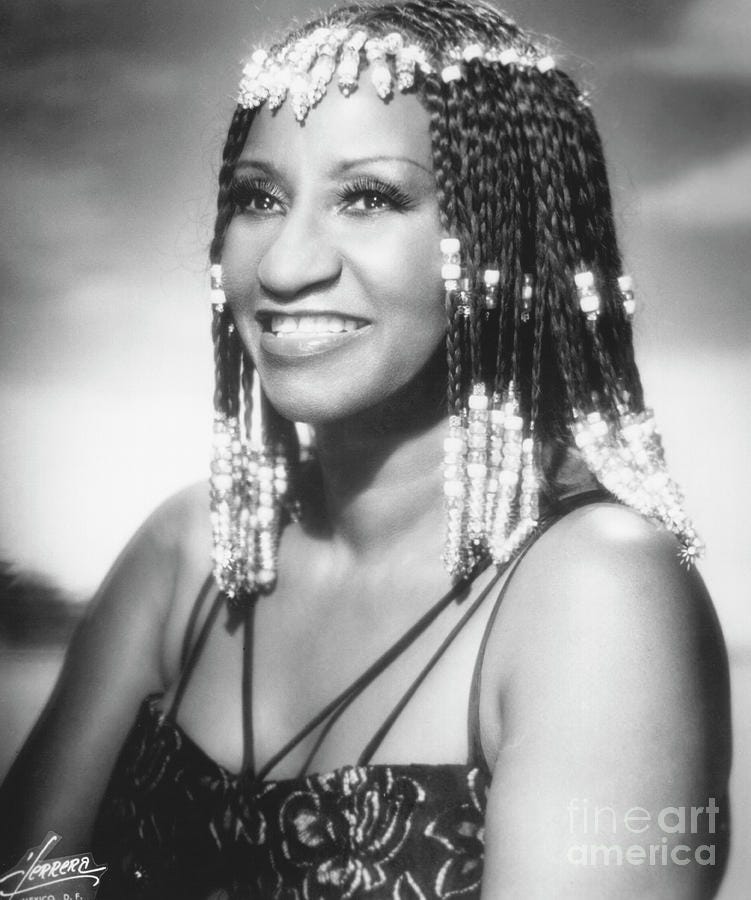
I felt as if I had met a goddess.
While the musicians (including my father) and sound technicians showed reverence, it was the sweetness her husband demonstrated that I distinctly remember. I’m not sure I had witnessed many examples of men exuding both masculinity and tenderness.
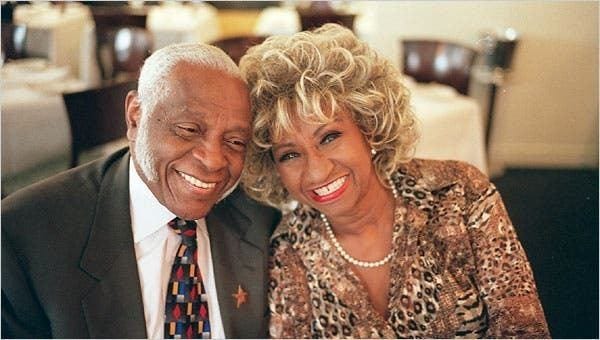
His appearance was striking—white hair and sideburns contrasting his chocolate skin. He was self-assured and smiling as he helped her with her coat. They joked that they still could never get used to New York winters.
I stared up at them as we rode down the elevator together.
Celia’s image is a kind of modern-day myth.
Her example has the potential to pull us towards radical questions:
How might we find joy as the world crumbles?
How can we summon the courage to use our voices?
How do we live more freely and authentically?
To me, Celia Cruz conjures another type of rebellion. Not joy despite darkness— joy as resistance to it. Not waiting for safety to feel alive. Searching for ways to invite in aliveness now.
My heart and soul felt every emotion expressed in today’s moments! From the grocery store to the privilege to the “thugs” ( i put this in quotes because I want them to be seen as irrelevant - not worthy of my pen) and then landing on Celia! La Reina! Azucar! As always my Sister Elo, you made my heart full💛 Thank you💋